
Comparison
Evaporative cooling or air conditioning: which is right in Morocco?
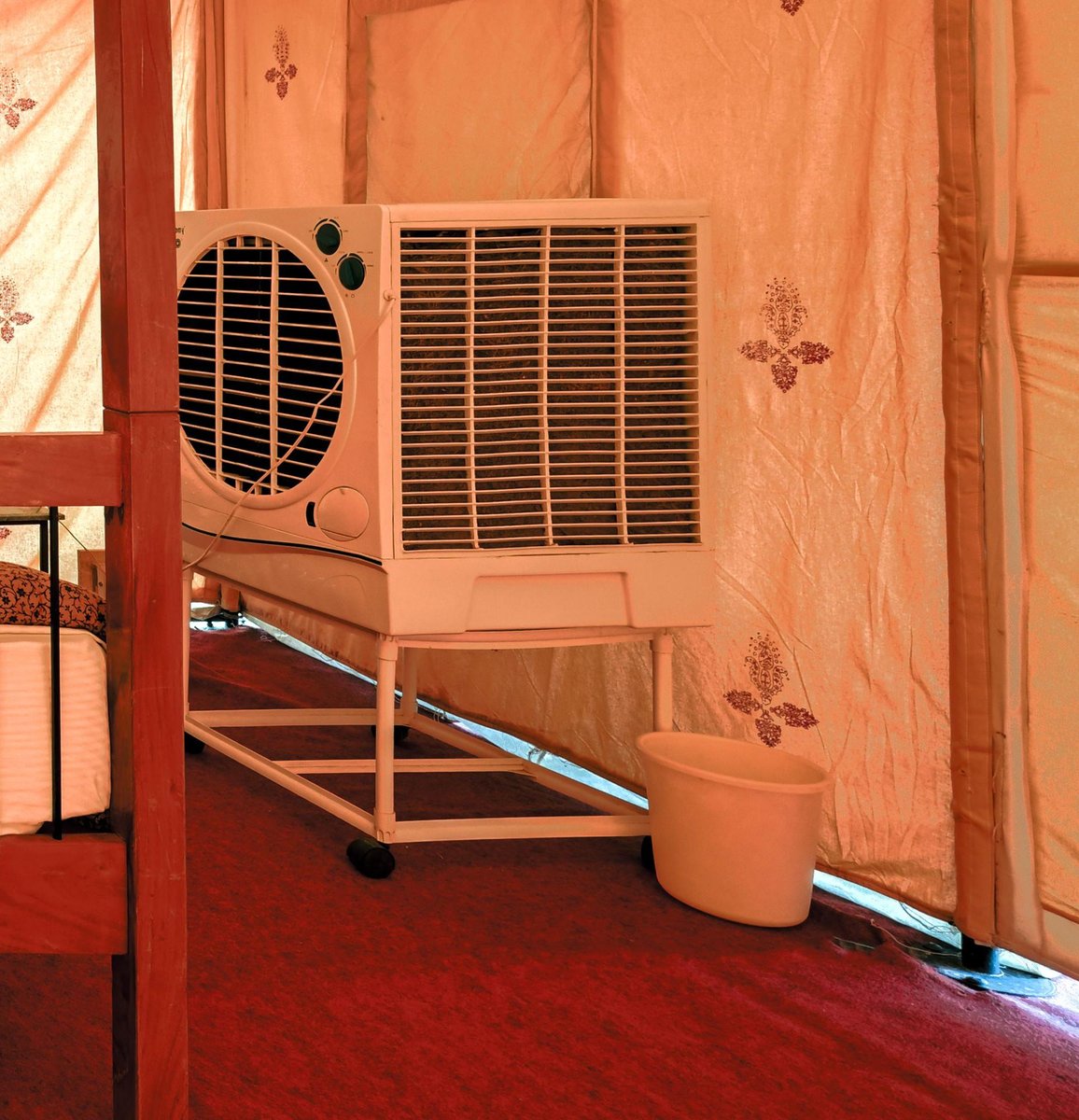
Evaporative (adiabatic) cooling cools air by evaporating water, with no compressor and no refrigerant: hot, dry air passes through a continuously wetted media, the water evaporates and takes heat out of the air, and the supply temperature can fall by several degrees — by as much as fifteen in the most favourable conditions. An evaporative cooler uses up to ten times less energy than an air conditioner of comparable capacity, but its performance depends directly on how dry the air is: it is highly effective in Marrakesh, Fez or Beni Mellal, considerably less so on the humid coast (Casablanca, Tangier, Agadir) in summer. For a large-volume workshop or warehouse, evaporative cooling is often the best comfort-to-cost ratio; for an enclosed space held at a set temperature (offices, server room, air-conditioned retail), air conditioning remains essential.
How does an evaporative cooler work?
The unit draws in outdoor air, passes it through an evaporative media kept wet, then supplies it into the space. Unlike an air conditioner, which recirculates indoor air, an evaporative cooler works on 100 % fresh air: the space therefore needs relief openings (roof lights, vents, doors, louvres) to let the excess air out. That is a health benefit — the air is constantly renewed — and a design constraint.
Evaporative cooling versus air conditioning
| Criterion | Evaporative cooler | Air conditioning (split, ducted, cassette) |
|---|---|---|
| Principle | Water evaporation, 100 % fresh air | Refrigeration cycle, recirculated air |
| Electricity use | Very low (up to ~10× less) | High, proportional to the cooling capacity |
| Refrigerant | None | Yes, with leak-tightness and inspection duties |
| Temperature control | No: a relative drop against outdoor air | Yes: a precise setpoint |
| Effect on humidity | Raises the humidity of the supply air | Dehumidifies |
| Favourable climate | Hot and dry (inland Morocco) | All climates |
| Suitable spaces | Workshops, warehouses, halls, terraces, hangars | Offices, retail, enclosed spaces with a setpoint |
The deciding factor in Morocco: air humidity
The hotter and drier the incoming air, the more intense the evaporation and the sharper the temperature drop. It is precisely during heatwaves that evaporative cooling performs at its best — exactly when the need is greatest. On a coastal site, though, where the summer air is already carrying moisture, the evaporation potential is reduced and the thermal gain becomes modest.
In practice: favour evaporative cooling for a site in Marrakesh, Fez, Meknes, Beni Mellal or Errachidia; study both options side by side for a site in Casablanca, Rabat, Tangier or Agadir, where summer humidity caps the performance.
When air conditioning remains unavoidable
For sizing an air conditioning installation, a first approximation works to around 100 to 150 W/m² for a retail space with a high internal heat load, or about 10 kW for 100 m² — a figure to be refined by a cooling load calculation that accounts for insulation, solar gains, lighting and equipment.
- Spaces held to a strict temperature setpoint: server rooms, laboratories, sensitive storage areas.
- Enclosed offices and retail units, where large volumes of air cannot simply be let out.
- Processes that need the air dehumidified rather than moistened.
- Small spaces where a split or a cassette is more than enough.
Mixed solutions
On many industrial sites the best answer is a hybrid one: evaporative cooling over the large production and storage volumes, air conditioning in the office areas, control rooms and plant rooms. That split covers summer comfort across the whole site without sizing an oversized refrigeration plant for halls that are difficult to seal.
Frequently asked questions
Is evaporative cooling effective in Morocco?
Yes, particularly in inland cities where the summer air is hot and dry: Marrakesh, Fez, Meknes, Beni Mellal, Errachidia. Evaporative cooling is all the more pronounced the drier the incoming air. On the coast (Casablanca, Tangier, Agadir) summer humidity reduces the evaporation potential and the thermal gain is more modest: both solutions then deserve to be compared.
How much less energy does an evaporative cooler use than an air conditioner?
An evaporative cooler has neither a compressor nor a refrigerant: it only consumes the fan power and the water circulation. Its electricity use is of the order of ten times lower than an air conditioner of comparable capacity, which translates into a very substantially reduced running cost over large volumes.
Do you need openings to install an evaporative cooler?
Yes, it is a condition of operation. An evaporative cooler works on 100 % fresh air: it continuously pushes air into the space, and that air has to be able to escape through roof lights, vents, louvres or doors. Without enough relief, the space goes into positive pressure and the unit loses its effectiveness.
Can a warehouse be cooled without air conditioning?
In most warehouses and production halls, yes. These buildings are too large and too loosely sealed to be air-conditioned on any reasonable economics. Evaporative cooling, combined with good high-level extraction, delivers real comfort at the workstations for very low energy use. Air conditioning is then kept for the site's offices and plant rooms.
Further reading
Our range of evaporative air coolers.
Read more Air conditioningSplit, ducted and cassette units for enclosed spaces.
Read more Air conditioning serviceCooling load studies, installation and maintenance.
Read more AHU or mechanical ventilation?Treating fresh air at building scale.
Read more